
Last updated September 10, 2026
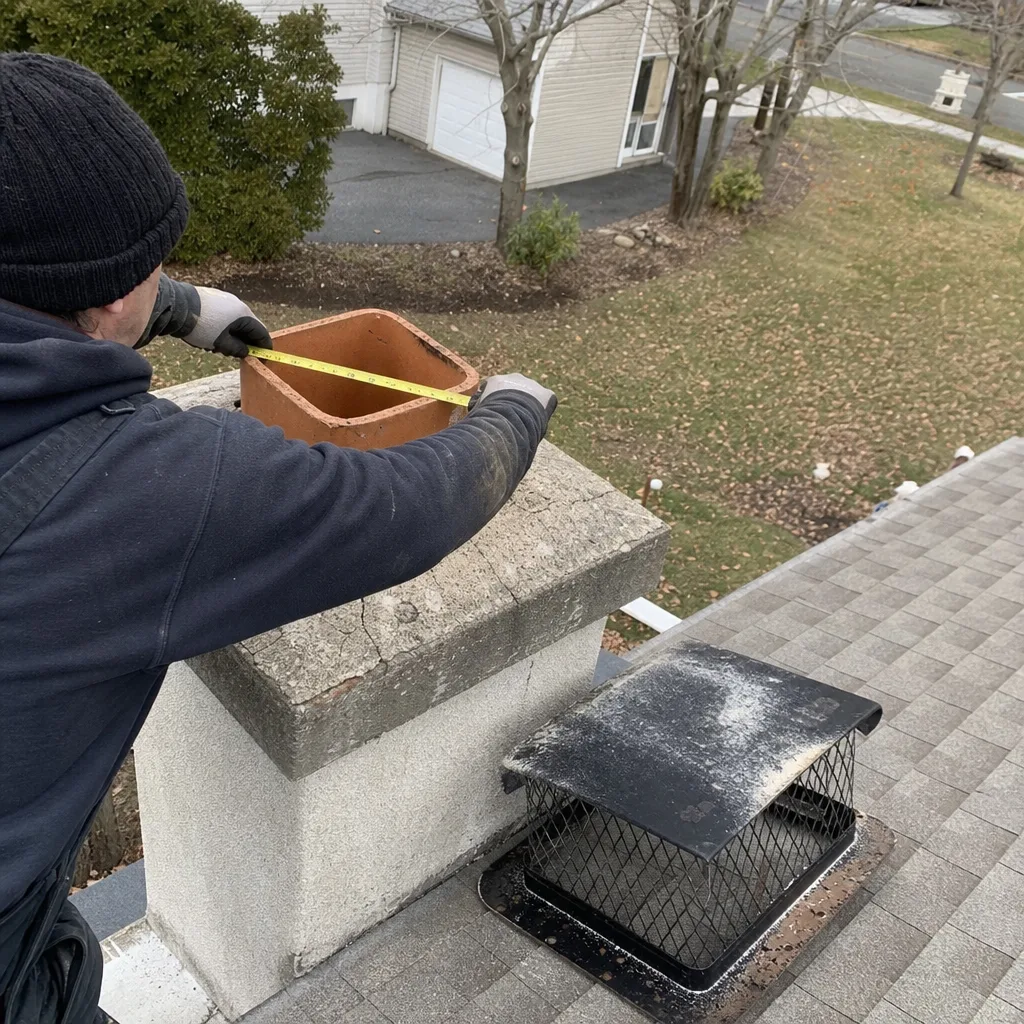
Level 1 sweep and inspection to the NFPA 211 annual standard - flue, crown, cap, and flashing checked and photographed
Chimney sweep logs do not sweep chimneys. They loosen some creosote - which then falls where a brush and vacuum still have to collect it.


 Before
 After
After Before
 After
After Before
 After
AfterChimney Cleaning Permits, Codes & Inspections in NJ: What You Need to Know
Here’s the thing nobody tells you until it’s too late: a standard chimney cleaning in New Jersey almost never requires a permit, but a chimney relining almost always does. The trouble starts when a contractor frames a relining job as “cleaning and repair” to skip the paperwork. You sign off, the work gets done, and if a fire happens later, the missing permit becomes your problem, not theirs. We’ve watched this play out in Woodland Park enough times that we now explain the permit landscape to every homeowner before we even quote a job. By the time you finish this guide, you’ll know exactly which jobs need a permit, which inspections matter, what documentation to demand, and how to protect yourself from the contractors who hope you never ask. For a deeper dive, see our Complete Guide to Chimney Cleaning in Woodland Park.
Quick Answer
Chimney cleaning (sweeping) does not require a permit anywhere in New Jersey, including Woodland Park. However, chimney relining, firebox rebuilding, and certain structural repairs do require a permit under the New Jersey Uniform Construction Code (UCC), specifically the building subcode. The permit must be pulled by a licensed contractor, the work must pass a municipal inspection, and the documentation should stay with your home’s permanent records. If unpermitted chimney work contributes to a fire, your homeowner’s insurance claim can be denied.
Table of Contents
- The Line Between Cleaning and Repair: Why It Matters
- NJ Uniform Construction Code: What Actually Triggers a Permit
- Woodland Park’s Local Inspection Office: What We’ve Learned
- NFPA 211 vs. Municipal Inspection: Two Different Animals
- The Insurance Risk Nobody Mentions
- What Documentation to Demand (and Keep Forever)
- Common Mistakes to Avoid
- When to Call a Professional
- Frequently Asked Questions
- The Bottom Line
The Line Between Cleaning and Repair: Why It Matters
The distinction between cleaning and repair isn’t just semantics. It’s the difference between a $200 brush job and a $3,000 to $8,000 structural project with legal requirements attached. In New Jersey, chimney cleaning falls under routine maintenance. No permit, no inspection, no paperwork. The state considers it the same category as changing your furnace filter or flushing your water heater.
But the moment you’re talking about relining a flue, rebuilding a firebox, replacing a crown, or installing a new cap that requires structural anchoring, you’ve crossed into territory governed by the building subcode. That means permits and inspections. And some sweeps, frankly, don’t want to deal with either.
Here’s what we see regularly in Passaic County:
- A chimney that needs a new stainless liner gets quoted as “cleaning plus a minor repair” with no permit pulled.
- The homeowner saves a few hundred dollars in permit fees and waits a few weeks less without inspections.
- The liner fails or a fire occurs, and the homeowner discovers their insurance won’t cover it because the work was never permitted.
- The contractor is unreachable, or has no license number to report to the state.
We won’t frame a relining job as a cleaning. It’s against code, it’s against the law, and it puts you, the homeowner, in a genuinely dangerous position. When Wendell Pike looks at a chimney in Woodland Park, he tells you straight: this is a brush job, or this is a permit job. There’s no third option.
Key Takeaway: Cleaning never needs a permit. Relining almost always does. If someone tells you otherwise, get a second opinion before you sign anything.
NJ Uniform Construction Code: What Actually Triggers a Permit
New Jersey operates under the Uniform Construction Code (UCC), which is adopted at the state level and enforced locally by each municipality’s construction office. The UCC is divided into subcodes: building, plumbing, electrical, and fire protection. Chimney work falls primarily under the building subcode, with the fire subcode sometimes involved when the work affects a fireplace or woodstove installation.
Here’s a breakdown of what requires a permit under the UCC as it applies to chimney work in New Jersey:
Work that requires a building permit:
- Chimney liner replacement or installation (stainless steel, aluminum, or poured-in-place like HeatShield or Gelco products)
- Firebox rebuilding or major masonry repair
- Chimney crown replacement when it involves structural repair to the flue or masonry
- Partial or complete chimney rebuilding
- Installation of a new chimney for a fireplace or woodstove
- Changing the flue size or configuration to accommodate a new appliance
Work that does NOT require a permit:
- Standard chimney sweeping and creosote removal
- Chimney cap replacement that does not involve structural anchoring (a simple friction-fit or screw-on cap)
- Minor crown sealing or crack repair that does not involve rebuilding
- Visual inspections and camera inspections (NFPA 211 Level 1 or Level 2)
- Cleaning of the smoke chamber or smoke shelf during routine sweeping
The critical dividing line is structural change. If the work changes the flue’s dimensions, replaces the flue’s lining material, or alters the firebox structure, the state requires a permit. If you’re simply removing creosote and soot, a brush and a vacuum are all the authorization you need.
What about the brand names? If you’re getting a liner from a recognized system like HeatShield, Gelco, Olympia Chimney, or Famco, the manufacturer typically requires professional installation by a licensed contractor. That’s not just a warranty condition. It aligns with the UCC requirement that structural chimney work be performed by someone who carries a valid New Jersey Home Improvement Contractor (HIC) registration. A permit is the state’s way of verifying that the right person did the job to code.
Woodland Park’s Local Inspection Office: What We’ve Learned
Woodland Park, like most New Jersey municipalities, enforces the UCC through its own construction office. The state code sets the minimum standard. The local office decides how strictly to enforce it and what documentation they want to see.
Based on our work in Woodland Park since 1999, here’s what we’ve learned about how the inspection process typically unfolds for chimney work:
- The contractor or homeowner files a permit application with the Woodland Park construction office. The application needs to describe the work in specific terms: relining a flue, rebuilding a firebox, replacing a crown.
- The construction official reviews the scope and determines which subcode inspections are required. For a typical relining, that’s usually one rough inspection (after the old liner is removed but before the new one is fully installed) and one final inspection.
- The rough inspection happens before the liner is sealed. The inspector verifies the flue dimensions, clearances to combustibles, and that the old hazardous liner (if any) was properly removed.
- The final inspection happens after installation is complete. The inspector checks that the liner is properly connected, the cap is installed, and the masonry is sound.
- If the work passes, the inspector closes the permit. You receive documentation that the work was inspected and approved. This is the paperwork that protects you later.
One thing worth knowing: Woodland Park’s local office can require documentation beyond what the UCC mandates as a minimum. In our experience, if you’re installing a liner like a DuraFlex system, having the manufacturer’s spec sheets and installation instructions on hand at the rough inspection can speed things up considerably. The inspector wants to see that the product is being installed according to the manufacturer’s listed requirements.
We also see seasonal patterns. Chimney inspections in Woodland Park pick up in late September and run heavy through November, before the first cold snap. If you’re planning work that requires a permit, applying in July or August can mean a much shorter wait for inspections.
And if you’re in Woodland Park and want a no-pressure assessment of whether your chimney work needs a permit, call Wendell at (973) 846-1622. He’ll look at the scope and tell you straight before you spend a dollar.
NFPA 211 vs. Municipal Inspection: Two Different Animals
Here’s a point that confuses a lot of homeowners in Woodland Park: an NFPA 211 chimney inspection and a municipal building inspection are not the same thing. They serve different purposes, they’re performed by different people, and you need to understand both.
An NFPA 211 inspection is the industry standard for chimney condition assessment. It follows the guidelines of the National Fire Protection Association, and it comes in three levels:
- Level 1: A visual inspection of the readily accessible portions of the chimney. This is what happens during a routine chimney cleaning in Woodland Park. The sweep looks at the firebox, flue, and exterior for obvious deterioration.
- Level 2: A camera inspection of the entire flue, typically required when you’re buying or selling a home, after a chimney fire, or after any event that may have compromised the chimney. This is what we do when we suspect hidden damage.
- Level 3: An invasive inspection that may involve opening walls or removing masonry to access concealed areas. Rarely needed, but essential when serious structural issues are suspected.
A municipal inspection, by contrast, is a code compliance check. The Woodland Park construction official isn’t assessing your chimney’s overall health. They’re verifying that the permitted work was done in accordance with the UCC. They check clearances, proper materials, correct sizing, and safe installation. They don’t necessarily run a camera through the flue, and they’re not primarily concerned with creosote levels.
Think of it this way: the NFPA 211 inspection tells you what’s wrong with your chimney. The municipal inspection tells you whether the permitted repair was done correctly. You should get an NFPA 211 Level 2 camera inspection before any repair work starts, and you should get a municipal inspection after the permitted work is completed. They work as a pair, and neither replaces the other.
When we do a chimney repair in Woodland Park, the sequence is always the same: camera inspection first, honest assessment second, written scope of work third, and if a permit is needed, we pull it before any tools come off the truck. The camera footage doesn’t lie, and we show it to you before we recommend anything.
The Insurance Risk Nobody Mentions
Let’s talk about the risk that rarely makes it into the marketing brochures: what happens to your homeowner’s insurance claim if unpermitted chimney work contributed to a fire.
The short answer: your claim can be reduced or denied outright. Insurance policies in New Jersey typically include language requiring that any work on the home be performed in accordance with local building codes and with the necessary permits. If a fire starts in a chimney that was relined without a permit, and the insurer determines that the work was done by an unlicensed contractor or failed to meet code requirements, they have grounds to deny coverage.
We’ve seen this happen to homeowners in Passaic County. A homeowner hired a handyman who installed a liner without pulling a permit. A year later, the liner failed, and the resulting chimney fire caused substantial damage. The insurance company sent an adjuster, discovered the liner was unpermitted, and the claim became a legal fight. The homeowner ultimately recovered less than half of the damage costs.
Here’s what you need to know:
The insurance company will ask for proof of permits. If a fire or structural failure occurs in a chimney that had recent work done, the adjuster will ask for documentation. If you can’t produce a closed permit from Woodland Park’s construction office, you’re starting from a very weak position.
Unlicensed work voids your leverage. If the person who did the work wasn’t a licensed NJ Home Improvement Contractor, you have limited recourse against them. Licensed contractors carry liability insurance and can be reported to the state. Unlicensed handymen often disappear.
The savings are fictional. Skipping a permit on a relining job in Woodland Park might save you $150 to $400 in permit fees. That’s the entire savings. Compare that to the potential exposure if something goes wrong, and the math is not complicated.
Wendell’s rule is simple: if the job needs a permit, the permit gets pulled. No shortcuts. The 90-Day Done Right Promise means nothing if we did the work without the legal paperwork that protects you. And when we’re done, you get the closed permit, the inspection results, and the camera footage on file. That’s how we’ve operated since 1999, and we’ve never had a claim denied for unpermitted work.
What Documentation to Demand (and Keep Forever)
Before any chimney work begins on your Woodland Park home, here’s the paperwork that should exist. If a contractor hesitates to provide any of these, that’s a red flag worth paying attention to.
- NJ Home Improvement Contractor (HIC) registration number. Any contractor doing home improvement work in New Jersey must be registered with the Division of Consumer Affairs. Wendell Pike’s number is published on every quote and invoice. If the number isn’t offered, ask for it.
- A written scope of work. This should describe exactly what will be done, in plain English. “Chimney cleaning and repair” is not a scope. “Remove existing terra cotta liner, install stainless steel DuraFlex liner, patch crown, install new cap” is a scope.
- A written estimate with a fixed price. The number on the estimate should be the number on the invoice. Beware of anyone who wants to give you a range and “see how it goes.”
- Proof of liability insurance and workers’ compensation. If the sweep falls off your roof or gets injured on your property, you don’t want to be holding that liability.
- The permit application and approval. If the work requires a permit, you should see the permit number and know who’s responsible for pulling it. In Woodland Park, the contractor typically pulls the permit, but the homeowner’s name goes on it.
- Post-inspection documentation. After the job is done, you should receive the closed permit, the inspection sign-off, and ideally a Level 2 camera inspection report showing the finished work.
- Manufacturer warranty documentation. If you installed a liner from HeatShield, Gelco, Olympia Chimney, or Famco, the warranty should be registered in your name with the manufacturer.
Keep all of this in a file and store it with your home’s permanent records. When you eventually sell your home in Woodland Park, a buyer’s inspector will ask about the chimney. Being able to hand over a folder with closed permits and inspection reports is a selling point that adds real value. It tells the buyer: this chimney was done right.
Quick tip: If you’re buying a home in Woodland Park and the seller can’t produce documentation for a recent chimney repair, call us at (973) 846-1622 for an independent Level 2 inspection. We’ll tell you what you’re actually buying before you sign.
For more on what to expect from a proper chimney restoration in this area, see our guide to Chimney Repair in Woodland Park. If the chimney or fireplace is new to you entirely, start with our Fireplace Services in Woodland Park overview.
When Woodland Park’s Local Rules Differ from the State Minimum
One of the most confusing parts of navigating chimney codes in New Jersey is that the UCC sets a floor, not a ceiling. Municipalities can enforce stricter interpretation, and in a town like Woodland Park, with a housing stock that ranges from 1920s colonials to 1980s split-levels, the local construction office sees a lot of variation in how older chimneys were built.
Here’s a specific difference we’ve encountered: the UCC’s building subcode allows some chimney liner repairs to be classified as “ordinary repair” if they’re limited to sealing minor cracks with a product like HeatShield. But the Woodland Park construction office has, in our experience, taken a more conservative view. If the existing liner is fractured to the point that a new liner system is being installed, they’ve generally required a permit, even when the repair technique is technically classified as a “repair” rather than a “replacement” under the manufacturer’s guidelines.
What this means for you: don’t rely on a contractor’s assertion that a permit “isn’t needed” because the state code classifies the work as repair. The local official has the final say. And any contractor doing regular work in Woodland Park knows this. If they’re telling you a permit isn’t required for a liner job, they’re either not familiar with how the local office operates, or they’re not being straight with you.
Another local nuance: Woodland Park is a smaller municipality, which means the construction office has limited staffing. Permit reviews and inspections can take longer in peak season. We’ve learned to build that timing into our project schedules. When you’re planning chimney work that requires a permit, the sequence that works best in this town is:
- Schedule the Level 2 camera inspection to document the problem.
- File the permit application as soon as the scope is confirmed.
- Book the work after the permit is approved, not before.
- Coordinate the inspection timing with the construction office as the work progresses.
Doing the work out of order means you’re paying for labor while the permit sits in review, or worse, installing materials that the inspector won’t be able to verify once they’re hidden behind finished surfaces.
Creosote, Chimney Fires, and the Hidden Coding Issue
Chimney fires are more common in New Jersey than most people realize, and they’re almost always caused by creosote buildup. But here’s the part that connects to codes: after a chimney fire, the temperature inside the flue can reach 2,000 degrees Fahrenheit, which is hot enough to crack terra cotta liners and compromise mortar joints. That’s why NFPA 211 requires a Level 2 inspection after any chimney fire.
And if that Level 2 inspection reveals a cracked liner, the repair triggers the permit requirement. You’ve now crossed from “cleaning” territory into “structural repair” territory. The chimney fire itself wasn’t your fault, necessarily, but the decision about whether to get the permitted repair is yours.
Here’s what we tell homeowners in Woodland Park about creosote:
- First-degree creosote is a light soot deposit. It’s a brush job. No permit, no inspection, no drama.
- Second-degree creosote is a thicker, flakier deposit. Still a brush job, but it might take more effort.
- Third-degree creosote is a hardened glaze. This is the stuff that causes chimney fires. It requires chemical treatment or power sweeping, and sometimes if it’s severe, the underlying liner already has damage.
The point: your flue doesn’t care how the fire looks. It cares how it breathes. Build up too much creosote and you’ve created the conditions for a chimney fire that can crack the liner, which then triggers a repair, which then triggers a permit. The $200 cleaning you skipped in October becomes an $8,000 liner replacement in March.
For the foundational service that prevents all of this, see our Chimney Cleaning & Sweep in Woodland Park page.
Common Mistakes to Avoid
- Assuming “repair” never needs a permit. In New Jersey, structural repairs to the chimney, firebox, or liner require a permit under the UCC. If the word “rebuild,” “replace,” or “reline” appears in the scope, assume a permit is needed until a licensed professional confirms otherwise.
- Letting the contractor frame everything as “cleaning.” Some sweeps use the word loosely to avoid the permitting process. If you’re paying for a liner installation, that’s not a cleaning. Demand the permit.
- Not checking the HIC registration. Any contractor working on your chimney in Woodland Park should carry a valid NJ Home Improvement Contractor registration. You can verify the number online through the Division of Consumer Affairs. We publish ours on every quote.
- Skipping the Level 2 camera inspection before buying a home. A standard home inspection rarely includes a full chimney camera scope. In older Woodland Park neighborhoods, cracked liners are common. The camera tells the real story.
- Not keeping closed-permit paperwork. The permit isn’t just about the work. It’s about your insurance protection and your future home sale. Keep every document in a permanent file.
- Delaying the cleaning season until November. In Woodland Park, the fall rush fills up schedules fast. Once a year, burn or no burn. Chimneys break in the off-season too.
- Trusting a quote that avoids the permit question entirely. If a contractor gives you a price for liner work and never mentions permits, that’s a sign they don’t intend to pull one. Ask the question directly: “Is this a permit job?” The answer tells you everything.
When to Call a Professional
If you’re in Woodland Park and any of the following apply, it’s time to get a professional opinion. If you’ve been told your liner needs replacing and you want a straight answer about whether it’s a permit job, call us. If you’ve had a chimney fire and haven’t had a Level 2 camera inspection, call us. If you’re buying or selling a home and the chimney’s condition is unknown, call us. If you’ve had national-chain work done and you’re not sure it was permitted, call us for an independent assessment. You can also explore more guides & resources on our blog.
Top Hat Chimney offers free estimates in Woodland Park. Wendell Pike will look at the scope and tell you whether a permit is legally required, whether the work can safely wait, and what the camera actually shows. Call (973) 846-1622.
And if you’re still orienting yourself to what your chimney or fireplace actually needs, start with the Top Hat Chimney home page for the full picture of what we do and where we work.
Frequently Asked Questions
No. Routine chimney sweeping and creosote removal are classified as maintenance and do not require a permit anywhere in New Jersey, including Woodland Park. You can schedule a cleaning without involving the construction office. However, if the cleaning reveals structural damage that requires a liner replacement or firebox rebuild, that repair work will require a permit under the UCC.
A standard chimney cleaning in Woodland Park typically ranges from $180 to $350, depending on the size of the flue, the amount of creosote buildup, and whether you’re combining it with a camera inspection. Top Hat Chimney always delivers upfront pricing before any work begins, and the number you hear on the phone is the number on the invoice. Call (973) 846-1622 for an exact quote.
If unpermitted chimney work is discovered during a fire investigation or a home sale inspection, you may be required to tear out and redo the work at your own expense. More seriously, if the unpermitted work contributed to a fire, your insurance claim can be reduced or denied. In New Jersey, the savings from skipping a permit are typically $150 to $400, which is a small fraction of the potential liability.
Once a year, burn or no burn. The NFPA recommends annual inspection and cleaning as needed. In Woodland Park, where many homes have wood-burning fireplaces used heavily from October through March, an annual sweep is the standard. Creosote accumulates with every fire, and chimneys also deteriorate in the off-season from freeze-thaw cycles and moisture intrusion.
You deserve proof before anyone touches your liner. A Level 2 camera inspection shows the inside of your flue in real time. If the liner is cracked, fractured, or missing sections, the camera footage will show it. If the liner is intact and only needs cleaning, the camera will show that too. At Top Hat Chimney, we show you the footage and explain what it means before we recommend any liner work. No camera evidence, no liner recommendation.
No. A municipal inspection verifies that permitted work complies with the New Jersey Uniform Construction Code. An NFPA 211 inspection assesses the overall condition of your chimney, using visual and camera methods, per the fire safety standards. You need an NFPA 211 Level 2 inspection before work begins to identify the problem, and a municipal inspection after work completes to verify code compliance. They serve different purposes and neither replaces the other.
The Bottom Line
Chimney cleaning in New Jersey never needs a permit. Chimney relining, firebox rebuilding, and structural repairs almost always do. The rules might feel like bureaucracy until something goes wrong, and then they’re the only thing standing between you and a denied insurance claim or a surprise bill at closing. If you’re in Woodland Park, the cleanest path is simple: get a camera inspection, get a straight answer about whether a permit is required, and only work with a contractor who publishes their name, their license number, and their price before a single tool comes off the truck. That’s how we’ve done it since 1999.
Written by Wendell Pike, Owner at Top Hat Chimney, serving Woodland Park since 1999.